
Before deciding to invest in SEO, most entrepreneurs want to know: How long does SEO take to show results? Paid advertising can generate immediate results, but SEO, being a long game, can bring to your site a steady, quality traffic and continuous growth. One of the ways of maintaining the commitment of the company to the process is knowledge of SEO timelines that are realistic.
We describe here the typical duration of SEO, the major factors influencing results, and the expected outcomes at various stages of SEO services.
The Short Answer: SEO Takes 3 to 6 Months (and Beyond)
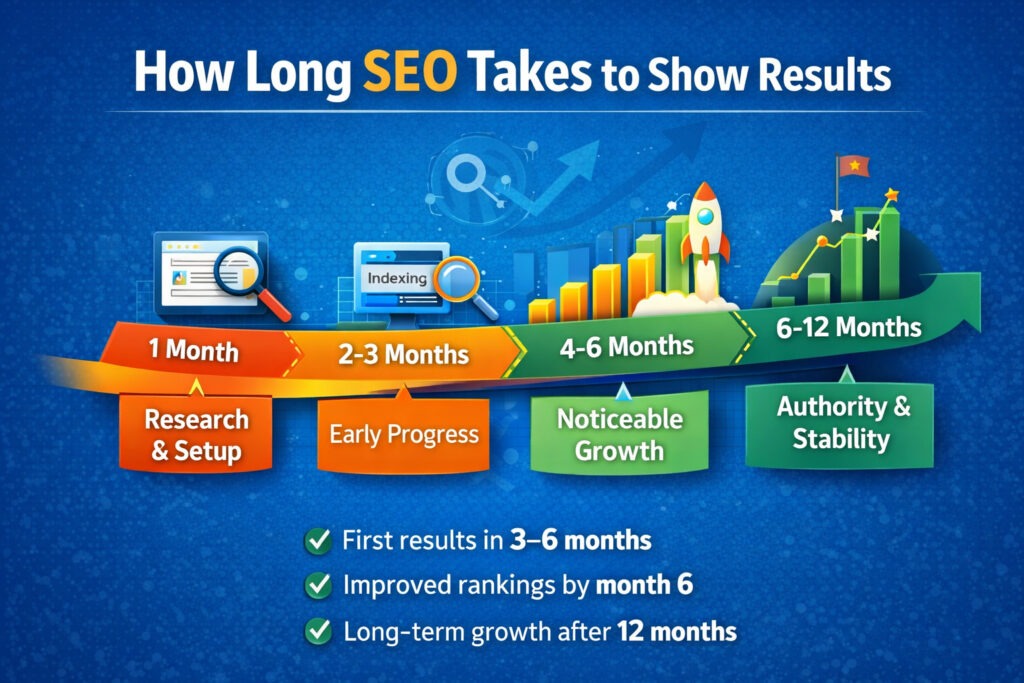
Generally, there is a 3 to 6-month period that SEO takes before you can see a change in rankings and organic traffic. Nevertheless, substantial and dependable outcomes might require 6 to 12 months, particularly where competition is fierce.
SEO is a strategy that grows on itself. Continued consistent execution over time will lead to stronger results.
Reasons for Slow SEO
Apart from paid advertisements, which provide instant results and guarantee a spot, the rest of the activities are about earning your place. Basically, SEO is a long journey where the trust, authority, and relevance of your website are recognized by the participants of the search engine ecosystems through a series of complex algorithms and the resultant changes in your rankings are also tested by search engines before they are finally displayed to the public.
Main reasons why SEO is slow:
- Search engines take some time to index updates.
- Development of authority and links is a gradual process.
- Content’s effectiveness is a matter of time.
- Changes in the competitors’ actions are always affecting the rankings.
SEO Timeline: Month-by-Month Guide to Expectations
Month 1: Preparation, Installation, and Base
Besides not focusing on rankings, this phase is all about planning. There are a couple of things that can be done here:
- Technical SEO audit
- Keyword research and competitor analysis
- On-page optimization
- Website structure and speed improvements
- Tracking setup (Google Analytics, Search Console)
Achievements:
There could be no significant ranking effects so far, though a wonderful base for success in the future has been established.
Months 2–3: Search Engines Becoming Familiar with Your Website
By then, the search engines will be getting ready to handle the changes you made to your website.
There are multiple things to consider:
- Publishing optimized content
- Improving internal linking
- Fixing crawl and index issues
- Initial link building
- Local SEO Service optimization (if applicable)
Results:
- Pages start indexing
- Rankings may fluctuate
- Small traffic increases for low-competition keywords
Here is the phase in which you can spot the signs of progress.
Months 4–6: A Phase of Marked Scalation
Such a moment is what can be termed as when SEO is actually “real”.
Things that need to be done are:
- Content expansion
- Authority building through back links
- Improving user engagement signals
- Optimizing conversion paths
Consequences:
- Ranking changes become obvious.
- Growth in organic traffic is steady.
- There are even some consistent leads or inquiries.
- Keyword visibility seems to be stronger.
For so many companies, it is at this moment that their SEO starts showing a return on their investments.
Months 6–12: SEO Becomes the Core Growth Engine
Once SEO has become the infrastructural part of the company’s growth engine. Here is some of the evidence:
- Page 1 rankings for high-intent keywords
- Better brand visibility
- Consistent traffic and leads
- Reduced dependency on paid advertising
Competitor-proof and algorithm-proof rankings wait through continual optimization.
Factors That Affect How Fast SEO Works
The speed of results differs greatly between websites. There are a few things that impact the time it takes for SEO to work:
1. Website Age & History
- New sites take more time
- Established domains look for results faster
2. Competition Level
- Local niches rank faster
- National and global keywords are more time-consuming
3. Content Quality
- High-value, search-focused content will get you ranked quicker
- Thin or duplicate content impedes progress
4. Back links & Authority
- Strong back link profiles speed up SEO
- Spammy links can delay or harm results
5. Technical SEO Health
- Fast, mobile-friendly sites rank quicker
- Technical errors delay indexing and growth
Is SEO Worth the Wait?
Yes—when done correctly. SEO delivers:
- Long-term organic traffic
- Higher trust and credibility
- Better conversion rates
- Sustainable lead generation
- Lower cost per acquisition over time
Unlike ads, SEO results do not disappear when spending stops.
How to Speed Up SEO Results (Safely)
While SEO cannot be rushed irresponsibly, results can be accelerated by:
- Targeting realistic keywords
- Publishing consistent, optimized content
- Fixing technical issues early
- Building high-quality backlinks
- Using data-driven strategies instead of shortcuts
Avoid “instant SEO” promises—they often lead to penalties.
Final Thoughts
So, how long does SEO take to show results?
The honest answer: SEO takes time, but the results are worth it. Initial improvements appear within 3–6 months, while long-term success builds over 6–12 months and beyond.
At Quick Page Traffic, we focus on sustainable SEO strategies that deliver measurable growth—not temporary spikes. If you are ready to invest in long-term visibility and consistent leads, SEO is one of the smartest digital decisions you can make.